Kidney failure
You will notice possible kidney insufficiency in rabbits at an early stage. A classic sign of impending kidney disease in rabbits is that the animal drinks noticeably more. You will typically observe the pet at the water bowl much more frequently and for significantly longer periods. Other signs include duller fur, apathy, and sunken flanks. Occasionally, motor impairments also occur. Animals with a history of EC are disproportionately more likely to develop kidney insufficiency.
What to do in case of kidney insufficiency?
If you notice the aforementioned signs, it's time to consult a veterinarian experienced with rabbits. First, you should check if your vet has the necessary experience treating rabbits. You can find lists of rabbit-savvy veterinarians online. Discuss your observations with the vet and ask them to take a blood sample. Blood collection in rabbits can be done successfully with sufficient experience, whether the blood sample is taken from the ear or the paw.
A darkening comfort towel helps keep the animal calm. Once a sufficiently large sample has been collected, it is sent to the lab. Some veterinarians have their own lab, so blood values can be available within 30 minutes. Ask for a copy of the blood values; you will need these for later comparative analyses. In the blood analysis for kidney disease, besides leukocytosis, massively elevated levels of urea and creatinine are noticeable. Additionally, changes in liver values are often found. To react correctly, the rabbit's kidney function at this stage – which can still seem lively without noticeable visible signs of illness – should be closely monitored.
Quick dietary change is necessary
If the diagnosis is confirmed, promptly change the animal's diet. From now on, all dry food is removed from the menu. In particular, no more dried herbs should be offered, as these have an exceptionally high calcium content. Hay may, of course, continue to be available. Furthermore, you should eliminate all fresh foods with a high calcium content: no carrot greens, no kohlrabi leaves, and no more kitchen herbs. Instead, fresh meadow feeding is recommended. Vegetables and fruits can also enrich the diet. Your rabbit should ideally not lose weight, as the substance will be needed later. Continue to ensure a varied diet. In the mix, you should feed water-rich and balanced foods. We have had good experiences with the following foods:
Diet:
- Cucumbers, tomatoes, bell peppers
- Napa cabbage & pointed cabbage
- Apples & pears, wild berries, watermelon
- Savoy cabbage, white cabbage & kale (occasionally)
- Hazelnut leaves, blueberry leaves, cherry leaves
- Corn greens, sunflowers, Jerusalem artichoke leaves
- Pear, plum, and apple leaves and twigs
- Currant, raspberry, and blackberry leaves
- Birch leaves
- Cranberries (unsweetened) as treats
- Wildflowers, wild herbs like nettle or ground elder in a mix
In addition to water, offer various drinks. It is important that the kidneys are well flushed to remove calcium. We found the following drinks gratefully accepted:
Additional drinks:
- Thin gruel of oat flakes (no longer than 14 days per course)
- Apple juice, pear juice, pineapple juice (1:10 diluted)
- Carrot juice (1:4 diluted)
- Tomato juice (1:4 diluted)
- Cucumber juice (homemade)
- Tea from birch leaves, plantain, nettles, or thyme (weak)
- Bladder and kidney tea (weak)
- Unsweetened cranberry juice (1:4 diluted)
[caption id="attachment_10088" align="alignnone" width="169"] Source: (c) DM, Example of cranberry juice, available at DM[/caption]
Infusions
At this point, you should learn how to administer an infusion. These infusions should be carried out by rabbit owners in a stress-free home environment under the guidance of the veterinarian. Let your veterinarian instruct you on how to do this. Also, discuss the amount and frequency at which the infusion with Ringer's solution (never Ringer's lactate!) should be given. From practice, we know of administering 100 ml every other day. However, the veterinarian decides how, what, and how much needs to be infused.
Infusion with Ringer's solution acts like a kind of dialysis and cleans the blood. Get enough cannulas and syringes, which must be discarded after each use. Don't worry, you will learn to infuse and grow with each administration. Give your beloved pet valuable and worthy life by giving subcutaneous home infusions. Experience shows - infusions work well. If the cooperation between veterinarian, rabbit owner, and rabbit patient works well, even in critical cases, many valuable years of life can be granted through intensive treatment with relatively painless infusions and tailored nutrition.
[caption id="attachment_10091" align="alignnone" width="300"] Ringer's solution
Source: (c) Firma Braun[/caption]
What is concomitant therapy?
As with all diseases, factors such as love & stress also affect the course of kidney weakness. Therefore, keep the animal in its group. The love of its conspecifics will have a positive effect. Conversely, avoid new introductions, as stress is a negative factor. In principle, one can be critical of homeopathic kidney treatment - nevertheless, our successes with it have been astonishing. First, it should be mentioned that various homeopathic methods can be used to support the treatment of kidney disease. Therapy with Renes/Viscum comp and SUC therapy from Heel (ampoules) are well-known. Choose one method and never administer both remedies at the same time. Due to better experience with SUC therapy, we would like to briefly present it.
SUC therapy from Heel (ampoules) for the biological treatment of chronic kidney insufficiency, derived from the initial letters of the biological preparations:
S = Solidago compositum ampoules
U = Ubichinon compositum ampoules
C = Coenzym compositum ampoules
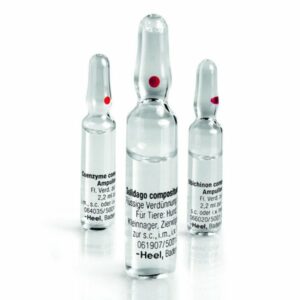
Source: SUC from Heel (c) Heel
Treatment plan for oral therapy at home:
Day 1 and Day 2
2 x daily subcutaneously, 1 ml each of S, U, C in one syringe
Day 3 – 7
1 x daily subcutaneously, 1 ml each of S, U, C in one syringe
From Week 2
Every other day orally, 1 ml each of S, U, C in one syringe
From Week 3
2 x weekly orally, 1 ml each of S, U, C in one syringe
From Week 8
1 x weekly orally, 1 ml each of S, U, C in one syringe
1 ml Solidago
1 ml Ubichinon
1 ml Coenzyme
plus 1 ml. Hepar comp (all in one syringe)
Continuation of treatment indefinitely, as long as the general condition is good.